http://www.independent.co.uk/news/business/news/exclusive-train-stations-could-be-hived-off-in-plan-to-split-up-network-rail-10273898.html
Tuesday, 26 May 2015


Monday, 25 May 2015
So Cameron really does want to leave the EU
The prejudices of the elderly should not blight the futures of their grandchildren
The Indy reports that the Tory government is planning to deny 16- and 17-year-olds the right to vote in the EU referendum which their Scottish cohort had in the poll on Scottish independence.My recollection of canvassing as a parliamentary candidate was that it was the middle-aged and elderly who were most prejudiced against the European Union, when the subject came up at all. The young people who I quizzed on the subject were at worst indifferent. Their main concern was in getting a job.
My friends in the party tell me that their children who have been able to take advantage of today's interchange of young people across the EU are enthusiastic about the opportunities this offers. Why should the generation which is most engaged not be allowed to participate?
Sunday, 24 May 2015
Destruction of physical heritage
Boyd Tonkin's piece in Saturday's Indy puts the trail of destruction wrought by ISIS/DAESH in perspective, both in time and place. He points out the desecration of ancient sites in Mecca by the very people who inherited the duty of preserving the holy places for their fellow-religionists, all in the pursuit of non-oil revenue. One can add another case of "friendly fire": the damage done to ancient ruins in Iraq by US forces.
The commanding officer in the latter case may have had little respect for Mesopotamian remains, but one wonders what would have been his reaction if an outside agency had requisitioned the Williamsburg estate, much younger and arguably less distinguished architecturally than Babylon or Palmyra, and treated it with the same disregard.
The composer Richard Strauss, who regarded himself as one of the guardians of German culture, wept over the bombing of Dresden. But there is no evidence of similar concern over the destruction of Coventry, Rotterdam or Warsaw by the Nazi regime to which he was in hock, nor even to the lives lost in any of those cities.
Clearly, we are dealing with symbols here. The Saudis are showing contempt for anything (apart from the black stone itself) that predates the emergence of their ruling sect. The puritan iconoclasts of the reigns of Henry VIII and his son Edward VI, and later of Oliver Cromwell, whose depredations Tonkin equates to those of DAESH, were showing their hatred of popery. But, as Tonkin also points out, much that was destroyed was beautiful in its own right, appealing to something in all of us, whether believers or not. Post-Enlightenment, he posits a growing belief in "common human patrimony". People are more important than things, but take away their cultural heritage and you degrade people.
A last word from Boyd Tonkin:
A visitor to Palmyra who has just posted pictures on the BBC website writes that he found something 'slightly disquieting about feeling so strongly about the destruction of such astonishing cultural artefacts given the likely human toll'. Only a marble-hearted aesthete would not share that twinge. Yet Heinrich Heine wrote the first, and last, word about such pangs of conscience: 'Where they burn books, they will in the end burn people too.' Many people know Heine’s line, which now graces a plaque on the Bebelplatz in Berlin, where the Nazis stoked their literary bonfire in May 1933. Fewer know its original context. It comes from his 1821 tragedy Almansor, and refers to burnings of the Koran by the Spanish Inquisition.
Saturday, 23 May 2015
Sophia Gardens before it became the Swalec
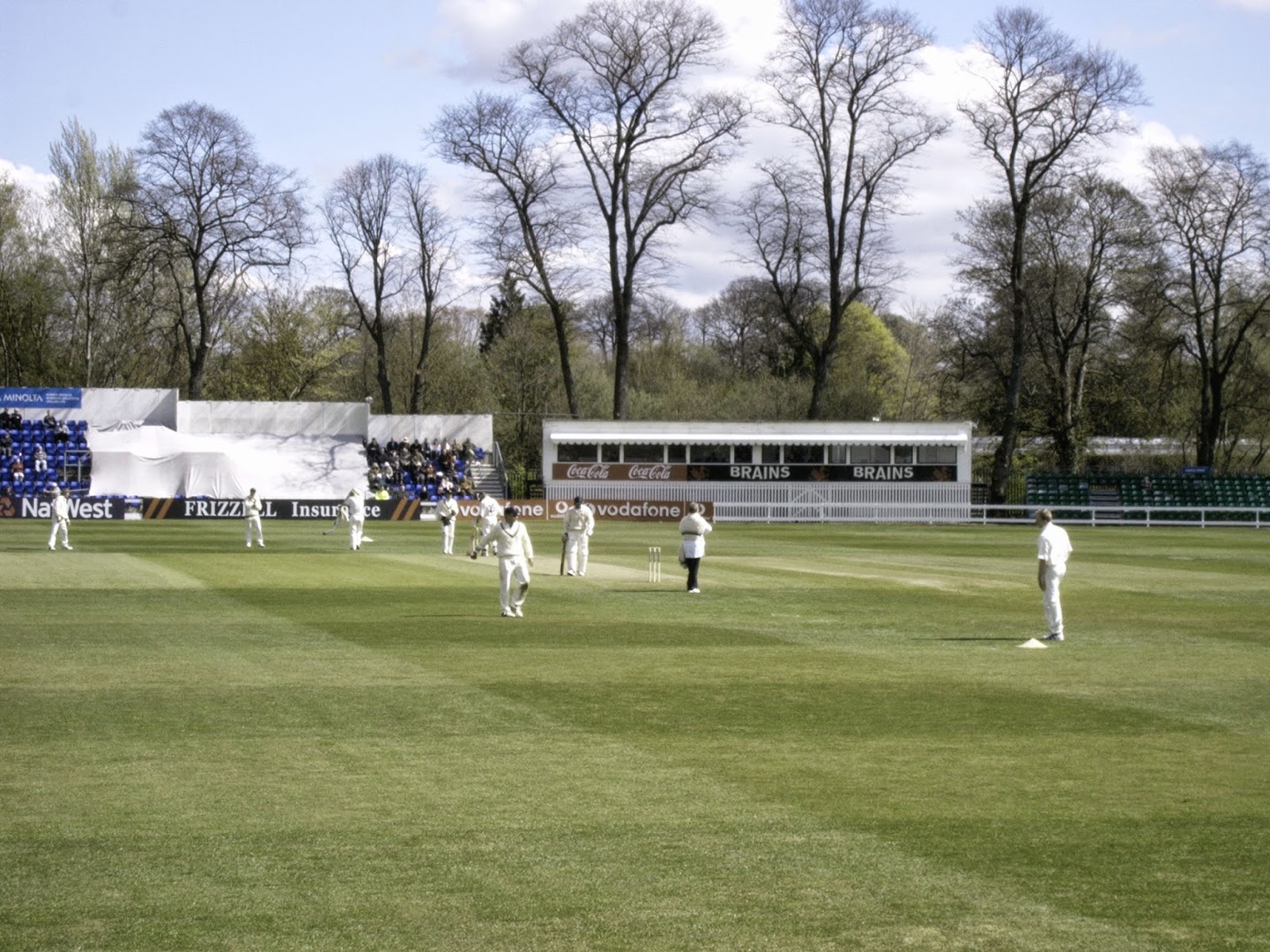
The date suggests that this was taken on the opening day of the home fixture against Derbyshire in 2004.
The River End looks different now!
 |
| Extract from Glamorgan CCC's cover picture at http://www.glamorgancricket.com/cricket/welsh/swalec_stadium.php |
Friday, 22 May 2015
Conservative parliament slipping back into old ways
I see from Guido Fawkes that no time has been lost in allocating select committee chairs "through the usual channels" to the various political parties. An opportunity was lost for the committees themselves to choose the most suitable person irrespective of party, though one trusts they will still be able to elect which Conservative (or Labourite or Nationalist) will take the chair.
As Sir Alan Beith said in one of his last contributions before retiring:
“It would be a retrograde step to return to appointment of chairs behind closed doors or just within parties. This would harm the standing of select committees in their role of holding to account the Government of the day”.
As Sir Alan Beith said in one of his last contributions before retiring:
“It would be a retrograde step to return to appointment of chairs behind closed doors or just within parties. This would harm the standing of select committees in their role of holding to account the Government of the day”.
Thursday, 21 May 2015
Poverty and unacceptable jobs
There was a rare treat on Laurie Taylor's Thinking Allowed this week: a contribution from a conservative (if not a Conservative) academic in the field of social policy. Labour is fond of saying that it is a myth that JSA claimants prefer to stay on benefits than take uncongenial jobs. Andrew Dunn provided evidence to the contrary, though rather too much of that evidence was from DWP staff rather than claimants themselves to settle all doubts. I would add that the difficulty and expense of getting to and from work is also a disincentive. I agree that most people would prefer the self-respect which work gives them, even if the balance of compensation is negligible, but it has to be recognised that there is a minority which would not.
Joanna Mack's summary of an exhaustive series of surveys over the last thirty years was even more sobering. Although some of what we regard as essentials today were seen as luxuries or unobtainable in 1980, it seems clear that the gap between rich and poor has widened since then. Moreover, there are far more people now than then who depend on in-work benefits.
Joanna Mack's summary of an exhaustive series of surveys over the last thirty years was even more sobering. Although some of what we regard as essentials today were seen as luxuries or unobtainable in 1980, it seems clear that the gap between rich and poor has widened since then. Moreover, there are far more people now than then who depend on in-work benefits.
Wednesday, 20 May 2015
I wish it were true
Stephen Tall relays and seems to agree with a recent Economist article which declares that liberalism is winning in the UK. It has become mainstream, adopted by all the other parties, so there is no need for a Liberal Democrat party any more.
However, one has to ask: what kind of liberalism? The Economist cites the fact that gay marriage, with a few objectors on Pauline grounds, has been accepted by the Conservatives and the opposition alike. But there is more to liberal democracy than embracing gender equality.
David Cameron's rhetoric about Conservatives ruling as a one-nation government does not convince either. It is clear that retaining the unitary nature of the UK was uppermost in his mind rather than eroding the differences between rich and poor. At the same time as he was making his "inaugural" Cameron already had at the top of his agenda of implementing manifesto promises the repeal of the Human Rights Act. Now, it could be that Michael Gove's Bill of Rights would give the same protections under the ECHR as the HRA did, without the need for complainants to go to Strasbourg, but the signs are not good. At best, there will be no room for judicial interpretation which will lead to hard cases.
We have been here before. The wartime coalition led by one-time Liberal Winston Churchill as it had victory in sight made liberal reforms. It commissioned the Beveridge Report. It implemented educational reform. Churchill would also have introduced a national health service if he had won the 1945 election. Liberal membership and supporters drifted largely to the Conservatives, following the absorption of the breakaway National Liberal party. (Incidentally, Mark Pack can add the pro-coalition manifesto of 1945 to his list of Liberal suicide notes.)
Harold Macmillan, who had served with distinction in the Great War and was later affected by witnessing a Jarrow march, and Edward Heath continued the liberal conservative consensus.
Then it was swept away by the doctrinaire Thatcher administration, as this historical analysis (which incidentally disposes of the Disraeli myth) by Mark Stuart in the Yorkshire Post explains.
I would argue that the UK would have been better served if a stronger Liberal party had been able to participate in government in 1978 and again in 1992. We must not allow complacency in these relatively good economic times (for one section of society) to weaken us further. We are still needed in Westminster, as well as Cardiff Bay and Edinburgh.
Tuesday, 19 May 2015
Wood pellets

It was good to see the fuel for WWT's Slimbridge reserve coming from a renewable resource, but, as the supplier admits:
So at present there is a non-renewable penalty to pay in the form of transport costs.
Subscribe to:
Posts (Atom)