Could it have been the imminence of the celebrations of Neil Armstrong's epic footstep which inspired the organisers of the FIFA Women's World Cup just concluded? Before each match, the spectators were encouraged to count down to the moment of kick-off, in English it should be noted. In the days of my youth, that would have raised tempers across the Channel. I seem to recall a prominent politician being slated across the French media for daring to give a TV interview to an anglophone station in English. The French have matured since then, while we seem to become more chauvinist.
Who invented the countdown? It appears that the honour should go to a George Chetwynd Griffith-Jones, writing as George Griffith in the late Victorian and early Edwardian ages. According to his wikipedia entry, his "short story The Great Crellin Comet, published in 1897, was the first story to not only include a 10-second countdown for a space launch (though a countdown of sorts is included in Jules Verne's 1887 novel, The Purchase of the North Pole), but also the first story to suggest that a cometary collision with the earth could be stopped by human intervention.".
Tuesday, 9 July 2019


Monday, 8 July 2019
Access for all to public transport
It seems that work is to begin on the next phase of Network Rail's ambition to make all rail stations in England and Wales accessible to disabled people. However, it will all be for nothing if train operating companies are not forced to provide the same access to trains. Stories like this are still all too common.
On the subject of ease of access to public transport, there would be a prime opportunity for the situation in Neath to be improved. The bus interchange at Victoria Gardens does not comply with current disabled access law and was possibly in breach when it was constructed. The crown post office (kept open while the Liberal Democrats were in coalition, it should be noted) has now been abandoned, joining the old Post Office Building alongside it. What ought to happen is that, while retaining at least the facade of the listed Post Office Building, a fully-accessible bus station should be built alongside Neath rail station giving passengers easy interchange between bus and train. That would have happened in the days when all the entities concerned were under a single ownership and an integrated transport system was official government policy.
On the subject of ease of access to public transport, there would be a prime opportunity for the situation in Neath to be improved. The bus interchange at Victoria Gardens does not comply with current disabled access law and was possibly in breach when it was constructed. The crown post office (kept open while the Liberal Democrats were in coalition, it should be noted) has now been abandoned, joining the old Post Office Building alongside it. What ought to happen is that, while retaining at least the facade of the listed Post Office Building, a fully-accessible bus station should be built alongside Neath rail station giving passengers easy interchange between bus and train. That would have happened in the days when all the entities concerned were under a single ownership and an integrated transport system was official government policy.
Saturday, 6 July 2019
A social climber
"Mavis Carne - his lean rapacious wife, trained like a greyhound for the vigorous athletics of social climbing"
- from South Riding (Winifred Holtby)
- from South Riding (Winifred Holtby)
Friday, 5 July 2019
Gaming the system
Under Jeremy Corbyn's leadership, Labour's front-bench speakers are predominantly state socialists. They tend to believe in the old Clause 4*, and certainly more firmly that there should be no private companies involved in the public sector at all. (There are of course counterparts on the other side of the Commons who believe that public service is intrinsically wasteful and where it cannot be abolished can always be rendered more efficient by handing it over to a commercial company.)
There was a good example of this "Four legs good, two legs bad" approach in the House yesterday. Leeds East MP Stephen Burgon took advantage of an Urgent Question granted by Speaker Bercow. The premise for the UQ was the completion of the legal process by which Serco was fined £19.2m (with costs) by the Serious Fraud Office for offences connected with electronic tagging committed between 2010 and 2013. (Conservatives loathe Bercow for his readiness to grant UQs to the opposition and indeed he may well have stretched the meaning of the word "urgent" here.) Burgon immediately widened the question from the particular to the general by condemning not only the Serco contract but also the employment of Carillion and the privatisation of prisons.
Carillion was a clear case of bad management. Only the most hardened communist would claim that the state should act as its own builder. However, there is a selection of construction firms out there even after the monopolistic march of Carillion. The client/provider model in the case of construction is straightforward. There is a clearly specified contract. When the builder fulfils it, he gets paid - albeit in stages on bigger contracts. There is no political philosophy involved. All the government department has to do is ensure that the firms on a short-list of tenderers are capable - and financially sound.
The picture on prisons is less clear. As the then minister responsible Rory Stewart pointed out, although there were private prisons which performed badly but also some still in the public sector which did so; conversely, there are private prisons which are ranked as satisfactory.
But trying to monetise purely social functions like the probation service is, in the words of the late Paddy Ashdown, a mug's game.
The point is that there is no one simple solution for every case. There should, though, never be a scenario where private providers are expected to make moral decisions. The onus is on ministers and especially their civil service advisers to ensure that involving private enterprise in a public service is appropriate and, if so, that contracts are drawn up so that a successful bidder is not able to game the system.
*"To secure for the workers by hand or by brain the full fruits of their industry and the most equitable distribution thereof that may be possible upon the basis of the common ownership of the means of production, distribution and exchange, and the best obtainable system of popular administration and control of each industry or service."
Thursday, 4 July 2019
Plight of migrants in Libya
The recent callous, deadly and apparently arbitrary air raid in the Tripoli suburb of Tajoura has drawn attention to the over thirty detention centres in Libya. What was part of a process devised by the EU as a humane alternative to migrants risking their lives on the open sea has proved to be anything but humane.
Who was responsible for the raid is still a matter of conjecture. The Qatar-based al-Jazeera points the finger at the insurgent forces of Khalifa Haftar, who has the backing of Egypt and the UAE. (Qatar supports the UN-recognised Libyan government in Tripoli.) Haftar denies responsibility, but the stance of the United States in blocking a Security Council condemnation suggests that Washington may suspect an Egypt or UAE connection.
Who was responsible for the raid is still a matter of conjecture. The Qatar-based al-Jazeera points the finger at the insurgent forces of Khalifa Haftar, who has the backing of Egypt and the UAE. (Qatar supports the UN-recognised Libyan government in Tripoli.) Haftar denies responsibility, but the stance of the United States in blocking a Security Council condemnation suggests that Washington may suspect an Egypt or UAE connection.
Wednesday, 3 July 2019
Brexit themselves invite Nazi comparisons
I usually avoid echoing memes which have gained wide currency. However, there seems to have been a concerted counter-attack by Nigel Farage's fan club to people on Facebook posting obvious comparisons between the orchestrated disrespect shown by the Brexit Party to the European Parliament and the disrespect shown by a section of the Nazi party to the Reichstag. The photographic evidence is clear:
as is the documentary evidence. Goebbels' strategy as set out in Der Angriff, his journal of propaganda, is strikingly similar to Farage's:
We are an anti-parliamentarian party [...] We enter the Reichstag to arm ourselves with the weapons of democracy. If democracy is foolish enough to give us free railway passes and salaries, that is its problem. It does not concern us. Any way of bringing about the revolution is fine by us. If we succeed in getting sixty or seventy of our party’s agitators and organizers elected to the various parliaments, the state itself will pay for our fighting organization.
Phrases such as "Remainers have lost the plot" and "it shows disrespect to the victims of Nazi atrocities [to compare Farage to Goebbels]" abound on Facebook. What these people are blind to is Brexit's clearly deliberate aping of the Nazi stunt. Is there another recorded instance of this offensive gesture in a parliament chamber?
Liberal Democrats do not believe in the House of Lords as presently constituted. However, our peers work within the system constitutionally to change it. Similarly, we are opposed to the Police And Crime Commissioner system, but while it is in operation we stand candidates to make the best of it. Even Sinn Fein, opposed as they are to Westminster's rule over Northern Ireland, do not make a hooligan demonstration in the Palace of Westminster: their MPs merely stay away.
This is not the first borrowing of Nazi iconography by Nigel Farage. His racist - and misleading - "immigrant threat" poster of 2016 echoes images from a Nazi propaganda film. His rhetoric, too, with his appeal to the common man deceived by those in power, could come straight from the Goebbels play-book.
Why does he do it? Partly because it works, just as Tim Bell was inspired by the Nazi machine in his promotion of Margaret Thatcher, but also, I suggest, to induce the obvious reaction by his opponents on social media. Look at these rabid Remainers, he seems to be saying, how can they compare me, your friend in the public bar who is only fighting for your freedom, with the monsters who enslaved and slaughtered millions? Why, I even welcome Jews to my party!
Actually, I have always thought Farage more like the comic opera figure of Mussolini than the more obviously evil Hitler. Fascist Italy, before the pact with Hitler, had no death camps and was not constitutionally anti-Semitic. It was still, however, socially repressive and undemocratic. Farage shares the fascist contempt for elected representatives and the intelligentsia. A Faragist Britain may not be genocidal, but it would be conformist, without friends as neighbours and, except for the self-appointed elite, impoverished.
Brexit party 2019.
Nazi party 1930.
Turning their backs to democracy.
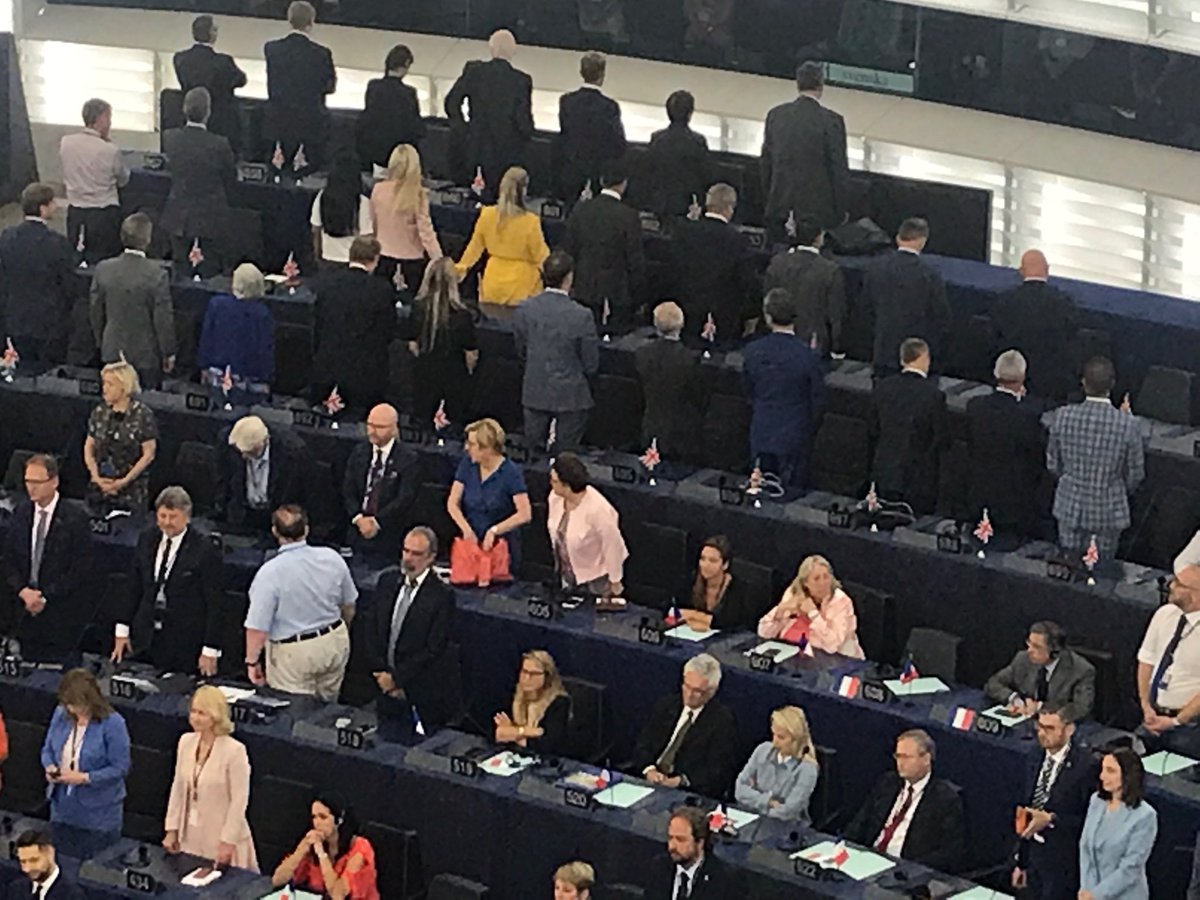
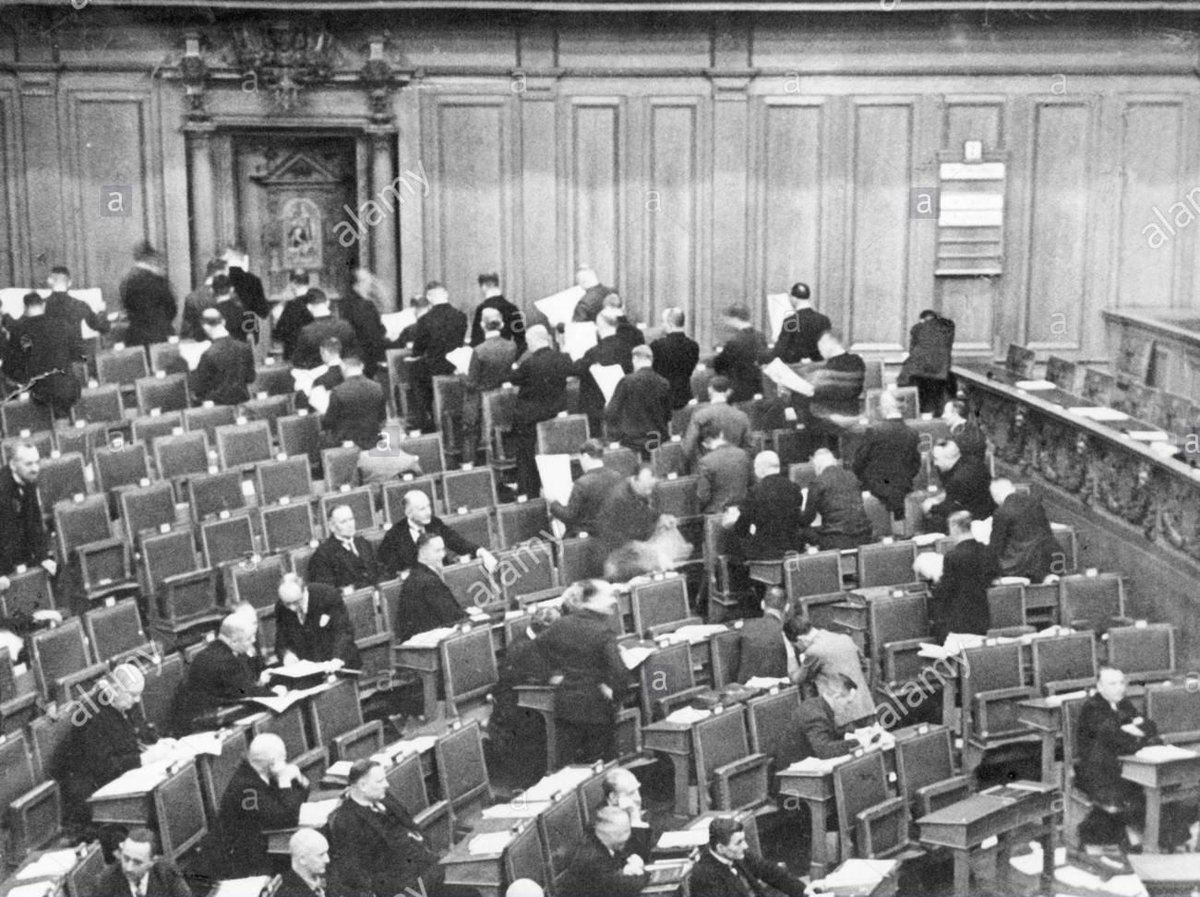
as is the documentary evidence. Goebbels' strategy as set out in Der Angriff, his journal of propaganda, is strikingly similar to Farage's:
We are an anti-parliamentarian party [...] We enter the Reichstag to arm ourselves with the weapons of democracy. If democracy is foolish enough to give us free railway passes and salaries, that is its problem. It does not concern us. Any way of bringing about the revolution is fine by us. If we succeed in getting sixty or seventy of our party’s agitators and organizers elected to the various parliaments, the state itself will pay for our fighting organization.
Phrases such as "Remainers have lost the plot" and "it shows disrespect to the victims of Nazi atrocities [to compare Farage to Goebbels]" abound on Facebook. What these people are blind to is Brexit's clearly deliberate aping of the Nazi stunt. Is there another recorded instance of this offensive gesture in a parliament chamber?
Liberal Democrats do not believe in the House of Lords as presently constituted. However, our peers work within the system constitutionally to change it. Similarly, we are opposed to the Police And Crime Commissioner system, but while it is in operation we stand candidates to make the best of it. Even Sinn Fein, opposed as they are to Westminster's rule over Northern Ireland, do not make a hooligan demonstration in the Palace of Westminster: their MPs merely stay away.
This is not the first borrowing of Nazi iconography by Nigel Farage. His racist - and misleading - "immigrant threat" poster of 2016 echoes images from a Nazi propaganda film. His rhetoric, too, with his appeal to the common man deceived by those in power, could come straight from the Goebbels play-book.
Why does he do it? Partly because it works, just as Tim Bell was inspired by the Nazi machine in his promotion of Margaret Thatcher, but also, I suggest, to induce the obvious reaction by his opponents on social media. Look at these rabid Remainers, he seems to be saying, how can they compare me, your friend in the public bar who is only fighting for your freedom, with the monsters who enslaved and slaughtered millions? Why, I even welcome Jews to my party!
Actually, I have always thought Farage more like the comic opera figure of Mussolini than the more obviously evil Hitler. Fascist Italy, before the pact with Hitler, had no death camps and was not constitutionally anti-Semitic. It was still, however, socially repressive and undemocratic. Farage shares the fascist contempt for elected representatives and the intelligentsia. A Faragist Britain may not be genocidal, but it would be conformist, without friends as neighbours and, except for the self-appointed elite, impoverished.
Tuesday, 2 July 2019
Public subsidy of private business
BBC Business this morning reported that President Trump has resumed his war of words over subsidies to Airbus. One trusts that the EU negotiators will counter-attack with the way in which US public bodies at various levels have supported their native IT industry and their plane-makers.
On top of that, we learn as a result of the 737 Max 8 disasters that the Federal Aviation Agency, whose advice tends to be followed by other certification bodies round the world, allowed Boeing to "mark their own homework".
Monday, 1 July 2019
Liberals attacked from all sides
In a Tweet, former leader of the Liberals and Democrats in the European Parliament Guy Verhofstadt has responded to President Putin's declaration that liberalism is obsolete: "Mr Putin and his far-right friends want Europe to become more unfree, because our tolerant, open, prosperous societies are a threat to their autocratic dreams and oligarchic interests. Motivation for all us to expand rights, freedoms and diversity in Europe."
Lib Dem leadership contender Jo Swinson rather dismisses Putin's significance: “Liberalism has faced down bigger challenges than Vladimir Putin, Boris Johnson or Viktor Orban. It’s survived and thrived on our continent for more than two centuries and through two World Wars. It’s not about to lay down to let nationalists and populists take over."
On the other side of the Atlantic, "liberal" has often been a term of abuse, never more so than in the conformist 1950s. Michael Goldfarb went further in 2010 in a historical analysis for the BBC News web-site.
On either side of the Atlantic - for that matter, wherever English is spoken - liberal means whatever the speaker says it means, although that is often not what the hearer thinks it means. Confusion reigns.
In America, neo-conservatives call themselves neo-liberals when it comes to economic theory. They advocate liberal interventionism in foreign policy.
It must befuddle Rush Limbaugh's fans to think that Britain's Conservative Party is in a coalition with the Liberal Democrats. [...] A couple of years ago, if you told an American that the Liberal Party was in power in Australia, the last thing he would have thought was that Liberal leader John Howard was a conservative slightly to the right of Ronald Reagan.
[...] And if you remind them that their other true British hero, Winston Churchill, started out a Conservative MP and then became a Liberal MP before returning to the Conservative fold, it absolutely makes their head spin.
The reason for Churchill's change of allegiance was trade policy. He was a free trader, but his Conservative colleagues believed in protective tariffs, so he crossed over to the Liberal benches in the House of Commons.
That happened around a century ago, and if you go back another century you get to the origins of the liberal confusion. According to most scholars, the word liberalism was first used in 1815 in English. It comes from the Latin word liber, meaning free. That part is easy to understand. Of course, what it means to be free is hard to pin down, and the methods for ensuring that governments allow their citizens to be free is equally muddy.
(I would add that Churchill, while solidly nationalistic to the point of being racist, was in many ways a social liberal when it came to the British people and remained so. As a Liberal colleague of Lloyd George he had introduced the wages councils, later to be abolished by Mrs Thatcher. One of his last contributions as war-time prime minister was to give RA Butler a free hand over the ground-breaking Education Act.)
Two years ago, Phillip Collins in the New Statesman added to the confusion:
In the US, the ideas of John Locke and Baron de Montesquieu are doing battle with Donald Trump’s, and we should all be thankful that, thus far, those of Locke and Montesquieu are winning.
Before asking who should speak for liberalism, we should note that liberalism is doing very well on its own account. Almost everyone is a liberal, although nobody likes the label. This is largely because no matter what sort of liberal you are, there is another sort of liberal that you are not. Any term that encompasses figures from Milton Friedman to Bernie Sanders, or from Nick Clegg to Daniel Hannan, runs the risk of including too much. For our present purposes, let us define a British liberal as someone who still believes that market capitalism delivers many more benefits than problems, who thinks that Britain is less prejudiced than it used to be and is glad of that, who is comfortable with recent levels of immigration, but who also believes that inequalities of power in Britain are too stark. It is immediately obvious from this description that, with credible leadership, this is a set of propositions that could command a majority of the British people. To this extent, the notion that Britain is somehow beyond liberalism is ridiculous.
He goes on:
It would be a disaster for the idea of liberalism for it to be bound up in the separate question of Britain’s membership of the EU. It is perfectly possible to be on opposing sides of that divide and remain a liberal, yet the demand for a second referendum is becoming, by default, the defining “liberal” cause.
Indeed, I know good Liberals who believe that the EU is an undemocratic organisation and that leaving it is a liberal act. For that, I blame the BBC.
Subscribe to:
Posts (Atom)