Friday, 9 June 2023

A serious AI threat

There has been unnecessary panic about a supposed threat to humankind from developments in artificial intelligence (AI). AI has been with us for a long time, from the philosophical discussions between Alan Turing and Donald Michie at Bletchley Park in wartime and the later ability to put their ideas into practice as second- and third-generation computers caught up with them. Turing died young, tragically and unnecessarily but Michie was able to capitalise on the transistor revolution. He founded at least one AI research unit and his regular column in Computer Weekly introduced his ideas to those of us who were making a living in commercial and administrative information technology.  (His centenary comes up in September this year. One trusts that he will be celebrated appropriately then.) 

By 1985, there were already real-world examples of the application of AI in the form of expert systems. Medical diagnoses and fault-finding in complex systems benefited from linking AI to faster and larger databases. Machine learning and artificial neural networks also became part of the mix. What has happened since then has been steady development in techniques and game-changing improvements in processing speed and memory capacity. It now looks like magic, as Arthur C Clarke observed.

But fast or slow, these systems lack the vital spark, the thing that distinguishes real life from artificial. They can never be self-aware or act on an initiative which is not implicit in their program. Even machines that learn can only do so within the parameters set down by their designers and coders. And, as one wag pointed out on the radio recently, if one does act dangerously due to a program bug or a hardware fault, all you need to do is pull the plug out.

The great new danger it seems to me is of evil people taking advantage of state-of-the-art simulation on broadcast media and the Web. (Fortunately, we are a long way from real-life robots indistinguishable from humans alla Westworld.) Already, as this Galaxy commercial featuring "Audrey Hepburn" showed, well-known figures can be made to appear in videos and movies long after they are dead. Text-to-speech systems have been with us for some time.  Linked to a program which can analyse speech patterns using surprisingly little material, there are applications which can appear to make (e.g.) politicians spout views diametrically opposed to their public stance. 

The possibilities are endless. Is that really Sir Keir Starmer praising private medicine? Is it really Sir Ed Davey having a conversation with John Redwood about a post-election coalition? Or Nigel Farage admitting he was wrong all along and that the UK's future is in Europe? Caroline Lucas praising the Aston Martin Bulldog and pressing for it to be put into production? 

Those were all extreme examples and easily detectable as fakes (except maybe the first). But more subtle fakes could easily take voters in and destroy what confidence remains in our electoral system. Perhaps politicians will be forced back to physical hustings ("this is really me, in the flesh"), which would be no bad thing.

Finally, there is an imminent threat to actors. In a notoriously insecure profession, many who have not made it on the stage or in feature film have been able to use their training to voice TV commercials or documentaries. Some like Christopher Tester, pen-pictured in the i recently,  have been very successful. Others may be just scraping a living. But all could be swept away by simulators. The bottom line has no scruples.


Thursday, 8 June 2023

Bill Lee

 When I bought my Bob Dylan "Bringing it all back home" LP there was no way I could know that the father of a future world-renowned film-maker was involved. Bassist and composer Bill Lee was a key member of Dylan's backing group for the studio sessions. He went on to compose the sound-tracks for son Spike's early films, as well as folk operas. He died at the end of last month. The New York Times obituary is here.


Wednesday, 7 June 2023

Those women conductors keep coming

Royal Opera has named Speranza Scappucci as principal guest conductor. Italian-born and Juilliard-trained, she has declared in the Guardian that she hopes to help demystify opera for British audiences.

In her native Italy, conductor Speranza Scappucci stars in a national television show in which she sits at the piano explaining symphonies and operas to viewers, before performing them with an orchestra, to help bring classical works to new audiences.

Until last year, she was music director of Opéra Royal de Wallonie-Liège in Belgium. In January last year, Scappucci – who has also conducted at the Met in New York, Staatsoper in Berlin and the Opéra National de Paris – became the first Italian woman ever to conduct at Teatro alla Scala in Milan.

Tuesday, 6 June 2023

John Morris, Lord Morris of Aberavon


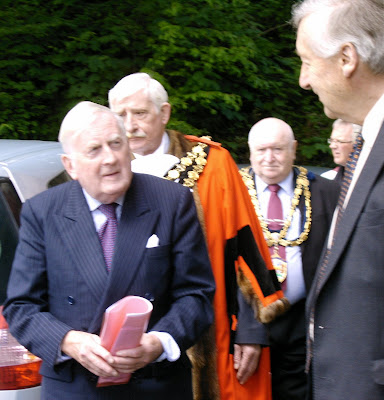
John Morris, former MP for Aberavon and government minister both as attorney-general and secretary of state for Wales, has just died. It would be fair to say that he divided opinion locally. His major contribution to the infrastructure of Port Talbot was the M4 urban motorway, which has proved a mixed blessing. 

However, friends and political opponents alike have acknowledged his unwavering support for devolution. His voice may well have been critical in the counsels of the national Labour party, which has traditionally been loth to devolve power from Westminster. 

The picture shows Lord Morris, the Mayor of Neath Port Talbot, the Mayor of Neath and Lord Livsey after a 2009 ceremony celebrating the memory of another former local M.P., Sir Samuel Thomas Evans..

Monday, 5 June 2023

Adam Smith tercentenary

 Claimed as an inspiration by many Conservatives, Smith was rather more liberal than they care to admit publicly.


Sunday, 4 June 2023

Johnstone and Anger

 The film world lost two significant writer/directors last month. Iain Johnstone died on 4th May, followed a week later by Kenneth Anger. Johnstone received - rightly - an extensive obituary on Radio 4's Last Word.  There was no way any Establishment outlet would memorialise Anger, who made his name with homoerotic short films before revealing the feet (and other body parts) of clay of such movie idols as James Dean in his book Hollywood Babylon. 

That in turn inspired Matthew Sweet to write Shepperton Babylon - thankfully not quite as racy as the Anger and very readable.

Updated 2023-06-07


Friday, 2 June 2023

Of hedgehogs and wrens - and monoglot English

 I was thinking about Brahms and his favourite hostelry, Zum roten Igel ((at the sign) of the red hedgehog),
as I drank a small coffee from one of my favourite cups. One of a set from scion living it features a cartoon hedgehog on a red ground. Why do Germans have such a short word for a hedgehog, but a longer one, where we have a shorter one, for wren? Zaunkönig, or king of the hedge, is certainly descriptive of the little bird which makes the loudest noise from the shrubbery. (Some lovely pictures here.)

Anyway, such trivia was soon swept aside by the worrying revelation on today's PM programme that only 2,200 students throughout England are to sit A-level German papers this year. (Last year's figures for 17-year-olds in Wales are equally depressing. Just 35 were recorded, in a nation which more than most should esteem polylingualism.) The figures for French and Spanish, spoken in more countries than where they originated, are slightly better, but the overall picture is one of the student population turning inward. Traditionally, German has been the language of science, clearly overtaken by English in the twentieth century, but surely still an important medium. That is on top of its continuing importance in literature, not to mention chess. It is all very sad.


Thursday, 1 June 2023

Uganda's homophobia goes beyond colonial-era law

Politico reports:

Uganda’s president has signed into law tough new anti-gay legislation supported by many in this East African country but widely condemned by rights activists and others abroad.

The version of the bill signed by President Yoweri Museveni doesn’t criminalize those who identify as LGBTQ, a key concern for campaigners who condemned an earlier draft of the legislation as an egregious attack on human rights.
 

[...]

Homosexuality was already illegal in Uganda under a colonial-era law criminalizing sexual activity “against the order of nature.” The punishment for that offense is life imprisonment.

The new law goes further. It

prescribes the death penalty for “aggravated homosexuality,” which is defined as cases of sexual relations involving people infected with HIV as well as with minors and other categories of vulnerable people. A suspect convicted of “attempted aggravated homosexuality” can be imprisoned for up to 14 years, according to the legislation.

Apart from the death penalty which has largely been abandoned in the civilised world, the Act takes no account of the fact that HIV in sub-Saharan Africa has been very much a heterosexual disease. 

Prospects for improved trade with Uganda are now remote, after promising beginnings.