From Robert Heckendorn's "On this day":
Jun 30 1817, Sir Joseph Hooker, botanist and zoologist, is born in Suffolk
Jun 30 1917, Lena Horne, entertainer, is born
Two people who made the world a better place.
Friday, 30 June 2017


Thursday, 29 June 2017
Tower block fires: some dates
1989 Alcoa inaugurates the Reynobond brand Aluminum Composite Material.
It is recommended for wall cladding among other uses. The company produces three grades of the material with increasing degrees of fire-resistance.
1996 Kensington and Chelsea council devolves control of its social residential properties to a tenant management organisation (TMO). Although ultimate responsibility remains with the council and two councillors are at all times on the TMO board, it is claimed that the organisation will be "tenant-led"
1999: a fire started on the fifth floor of Garnock Court, a 14-storey residential block at Irvine in Ayrshire. One person dies. The building had been refurbished with new uPVC windows and polyester sheet cladding.
2000 a parliamentary inquiry into the Garnock Court fire reports. It does not condemn retro-fitting of wall cladding, but recommends improved fire testing procedures
2003 The Building (Scotland) Act passed.
2004 Building (Scotland) Regulations made under the 2003 Act which come into force on 1 May 2005. They contain the mandatory regulation: "Every building must be designed and constructed in such a way that in the event of an outbreak of fire within the building, or from an external source, the spread of fire on the external walls of the building is inhibited." There is no corresponding action in Westminster.
2006 Fire safety law in England changes in October 2006 with the introduction of the Regulatory Reform (Fire Safety) Order 2005.
2006 Audit Commission team gives Kensington & Chelsea TMO a three-star rating. Leader of AC team later joins the TMO and eventually becomes its deputy chief executive
2007; and
2008: tenant members of the Kensington & Chelsea TMO call unsuccessfully for extraordinary meetings to discuss fears over safety, financial malpractice and maintenance.
2009 A fire rages through Lakanal House, a 14-storey block built in 1958 in Camberwell, south-east London. Six people were killed, among them two children and a baby, when a fire caused by a faulty television in a ninth-floor home guts the building. The council is investigated over possible corporate manslaughter charges, but eventually is fined £570,000 under fire safety laws. No further action is taken.
2010 Tenants Services Agency abolished by coalition government with a view to cutting costs while giving increased power to tenants of social housing.
2013 Grenfell Action Group starts raising fire safety fears, with particular regard to emergency service access to the flats tower.
In July a power surge in the tower kills a large number of electrical appliances. The TMO does not respond to concerns.
2014 GAG asserts that Grenfell Tower is a fire trap.
2015 Welsh government mandates sprinklers in new builds and change of use of houses and flats, care homes, rooms for residential purposes (other than in a hotel, hospital, prison or short stay leisure hostel), registered group homes and sheltered housing, as from the following January. There is no corresponding action in Westminster and builders protest at needless extra cost.
2016 Alcoa changes its trading name to Arconic
2016 Conservative Business Secretary unveils measures that will help deliver the government’s commitment to cut a further £10 billion of red tape.
2017
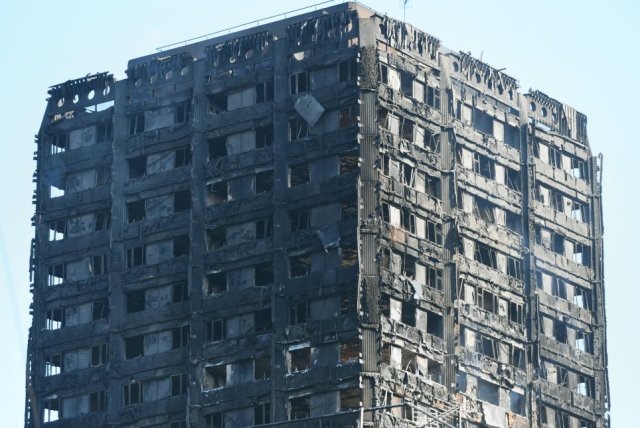
There is more at https://grenfellactiongroup.wordpress.com/2017/06/29/grenfell-tower-the-truth-will-out/ and http://www.private-eye.co.uk/issue-1447/news
It is recommended for wall cladding among other uses. The company produces three grades of the material with increasing degrees of fire-resistance.
1996 Kensington and Chelsea council devolves control of its social residential properties to a tenant management organisation (TMO). Although ultimate responsibility remains with the council and two councillors are at all times on the TMO board, it is claimed that the organisation will be "tenant-led"
1999: a fire started on the fifth floor of Garnock Court, a 14-storey residential block at Irvine in Ayrshire. One person dies. The building had been refurbished with new uPVC windows and polyester sheet cladding.
2000 a parliamentary inquiry into the Garnock Court fire reports. It does not condemn retro-fitting of wall cladding, but recommends improved fire testing procedures
2003 The Building (Scotland) Act passed.
2004 Building (Scotland) Regulations made under the 2003 Act which come into force on 1 May 2005. They contain the mandatory regulation: "Every building must be designed and constructed in such a way that in the event of an outbreak of fire within the building, or from an external source, the spread of fire on the external walls of the building is inhibited." There is no corresponding action in Westminster.
2006 Fire safety law in England changes in October 2006 with the introduction of the Regulatory Reform (Fire Safety) Order 2005.
2006 Audit Commission team gives Kensington & Chelsea TMO a three-star rating. Leader of AC team later joins the TMO and eventually becomes its deputy chief executive
2007; and
2008: tenant members of the Kensington & Chelsea TMO call unsuccessfully for extraordinary meetings to discuss fears over safety, financial malpractice and maintenance.
2009 A fire rages through Lakanal House, a 14-storey block built in 1958 in Camberwell, south-east London. Six people were killed, among them two children and a baby, when a fire caused by a faulty television in a ninth-floor home guts the building. The council is investigated over possible corporate manslaughter charges, but eventually is fined £570,000 under fire safety laws. No further action is taken.
2010 Tenants Services Agency abolished by coalition government with a view to cutting costs while giving increased power to tenants of social housing.
2013 Grenfell Action Group starts raising fire safety fears, with particular regard to emergency service access to the flats tower.
In July a power surge in the tower kills a large number of electrical appliances. The TMO does not respond to concerns.
2014 GAG asserts that Grenfell Tower is a fire trap.
2015 Welsh government mandates sprinklers in new builds and change of use of houses and flats, care homes, rooms for residential purposes (other than in a hotel, hospital, prison or short stay leisure hostel), registered group homes and sheltered housing, as from the following January. There is no corresponding action in Westminster and builders protest at needless extra cost.
2016 Alcoa changes its trading name to Arconic
2016 Conservative Business Secretary unveils measures that will help deliver the government’s commitment to cut a further £10 billion of red tape.
2017
There is more at https://grenfellactiongroup.wordpress.com/2017/06/29/grenfell-tower-the-truth-will-out/ and http://www.private-eye.co.uk/issue-1447/news
Wednesday, 28 June 2017
Google misuses market dominance
Do you automatically think streetmap.co.uk if you want to produce an online street map? I suggest that most people (including myself hitherto!) simply type in a postcode or street name to their browser and are automatically directed to Google maps. For that reason, Streetmap.EU Ltd's commercial director, Kate Sutton, went to the High Court in 2016 to seek a ruling against the multi-national giant, but was disappointed.
Now the European Commission has after lengthy deliberation come to a different conclusion over Google's misuse of its market dominance. The EC found that it unfairly favoured its own comparison shopping service over rivals in searches and fined the US behemoth €2.42bn.
The story is not over. Google may well appeal against the decision. Its main plank has been that the EC ruling "stifles innovation". This image of a nimble start-up trying to break through with a flash of mathematical insight may have appealed when Google was founded, but Alphabet (the parent company) is now as far removed from that in terms of capitalisation as the Ford Motor Company is from the Model T. The EC's spokesperson has already squashed the argument:
Commissioner Margrethe Vestager, in charge of competition policy, said: "Google has come up with many innovative products and services that have made a difference to our lives. That's a good thing. But Google's strategy for its comparison shopping service wasn't just about attracting customers by making its product better than those of its rivals. Instead, Google abused its market dominance as a search engine by promoting its own comparison shopping service in its search results, and demoting those of competitors.
Now the European Commission has after lengthy deliberation come to a different conclusion over Google's misuse of its market dominance. The EC found that it unfairly favoured its own comparison shopping service over rivals in searches and fined the US behemoth €2.42bn.
The story is not over. Google may well appeal against the decision. Its main plank has been that the EC ruling "stifles innovation". This image of a nimble start-up trying to break through with a flash of mathematical insight may have appealed when Google was founded, but Alphabet (the parent company) is now as far removed from that in terms of capitalisation as the Ford Motor Company is from the Model T. The EC's spokesperson has already squashed the argument:
Commissioner Margrethe Vestager, in charge of competition policy, said: "Google has come up with many innovative products and services that have made a difference to our lives. That's a good thing. But Google's strategy for its comparison shopping service wasn't just about attracting customers by making its product better than those of its rivals. Instead, Google abused its market dominance as a search engine by promoting its own comparison shopping service in its search results, and demoting those of competitors.
What Google has done is illegal under EU antitrust rules. It denied other companies the chance to compete on the merits and to innovate. And most importantly, it denied European consumers a genuine choice of services and the full benefits of innovation."
One of my reasons for wanting the UK to stay under the EU umbrella is just such resistance to large multi-national companies which is much more difficult for individual nations to maintain. EC antitrust rulings (one recalls a similar decision against Microsoft misusing its dominant position in the OS market) also rebut the view of socialists like Jeremy Corbyn that the EU is just a capitalist club.Tuesday, 27 June 2017
The man who predicted Neptune
A boy born in abject poverty in the alpine region south of Lake Geneva 250 years ago grew up to be one of the greatest mathematical astronomers. I must admit I had heard of Laplace and le Verrier, but not of the man who contributed greatly to their work, Alexis Bouvard. At least the Australians have a constant physical reminder in the shape of Cape Bouvard in Western Australia.
Monday, 26 June 2017
Linen-chest politics
The Americans would call Mrs May's bribe to the DUP to keep quiet during key votes "pork-barrel politics". Because of Ulster's best-known export, perhaps we should call it "linen-chest politics". If there were any justice, there would be a consequential annual top-up payment of £1.6bn to Wales, but of course Mrs May knows that her small band of Welsh MPs will never rebel. Realpolitik rules.
Government apologists will point to the Swansea City Deal of £1.3bn, but that money is spread over five years at least. Mrs May should immediately make some amends by insisting the GWR electrification should be wrenched back to its original timetable, increasing prosperity for the whole of South Wales, not just the Bay region.
The Barnett by-pass
The Scots seem to be rather worse done by than us in Wales in terms of top-ups. If they had an NI equivalent top-up outwith the Barnett formula, I calculate they are due £6bn over the two years that the agreement with the DUP is to run. I have just heard Damian Green reeling off a list of Scottish city deals and contributions to arts projects which top up Barnett, but my mental arithmetic produces a total of £693m.And what about the English regions? One can well imagine Tory MPs in the English south-west becoming restive. The Cornwall devolution deal may not be enough to satisfy them.
Updated 08:45 2017-06-27
Women in science
This France24 series, with its weekly daytime slot, looks admirable. One would have expected a French medium to be rather chauvinist but instead this programme is refreshingly international.
Saturday, 24 June 2017
John Simon
Probably the first Jamaican-born MP died on this day in 1897. More to the point, John Simon stood up for British Jewry, though he represented Dewsbury, a seat with a minimal Jewish community. (Dewsbury today has a large immigrant population, mostly Muslim.) He was only the second professing Jew to be admitted to the Bar of England and Wales.
Subscribe to:
Posts (Atom)